Signed in as:
filler@godaddy.com

He originally performed straitjacket escapes behind a curtain to preserve the illusion of superhuman technique. Crowds started chanting for him to do it in full view — and the public‑escape version became the iconic one.
The Westcar Papyrus (c. 1700 BCE) contains stories of conjurers performing decapitation illusions, crocodile control, and object animation for the Pharaoh.
Depictions appear in Roman frescoes, but also in Ptolemaic Egypt and possibly earlier.
It’s one of the few tricks performed continuously for over 2,000 years.
Vernon traveled North America trying to find someone who could perform a sleight he couldn’t detect.
He finally met Allen Kennedy, a Missouri gambler with a legendary center deal
Her name was Magdalen of the Netherlands, and she performed conjuring for Emperor Charles V.
Women have been in magic far longer than most histories admit.
The first public sawing illusion (P.T. Selbit, 1921) did not involve a saw blade passing through the body.
The assistant was enclosed in a crate and ropes were “sawed” — the blade-through-body version came later.
He and his brother Dash ran a small shop in New York. It failed — but the experience shaped Houdini’s lifelong obsession with magic dealers and apparatus makers.
Davenports (London, founded 1898) has been run by four generations of the Davenport family.
Their archive is one of the richest private magic collections in the world.
The earliest theatrical levitations trace back to John Nevil Maskelyne in the 19th century.
His “Psycho” automaton also played whist — and beat humans.
Maskelyne again. He created the first coin‑operated lock in 1893, charging a penny — the origin of the phrase “spend a penny.”
At least 12 documented deaths, including Chung Ling Soo (William Robinson), who died performing it in 1918. Houdini refused to attempt it, calling it “suicide.”
Harry Blackstone Sr.’s famous “rabbit from the hat” was actually a white guinea pig — easier to conceal and less likely to kick.

The cuffs were presented as unpickable, made by a London locksmith.
Modern research suggests the locksmith secretly colluded with Houdini’s manager, not Houdini himself — meaning Houdini may have been fooled by his own publicity machine.
Jean-Eugène Robert-Houdin used early electrical devices as practical stage tech: silent cues, electromagnets, and lighting tricks. His “Light and Heavy Chest” is one of the earliest examples of electromagnet-based deception.
William Robinson performed in “Chinese” persona for years without uttering a word in English.
When he was fatally shot during the bullet catch, his first words onstage were:
“Oh my God, something’s happened… lower the curtain.”
In the 1800s, Buatier de Kolta created a levitation where the floating figure was actually a cleverly disguised assistant inside the drapery. The wire‑based “Asrah” levitation came later.
It advertised Pinetti, a flamboyant Italian conjurer who toured Europe with mechanical birds, automata, and proto‑escape acts. He was also notorious for feuding with other magicians in print.
The earliest references (early 1800s) appear in political cartoons mocking politicians as “conjurers.”
Magicians later adopted the gag as an actual stage effect

His “handcuffed jump from a bridge” publicity stunts were done in freezing rivers with unpredictable currents. He nearly drowned in Pittsburgh when his hands became entangled in debris.
Early dealers like Martinka & Co. (late 1800s) produced handwritten or hand‑typed lists of apparatus for select customers. Printed catalogs came later — and became collectibles in their own right.
Despite hundreds of eyewitness accounts, no verifiable performance has ever been documented.
Most historians believe it was a newspaper hoax that spiraled into folklore.
The legendary African American magician (early 1900s) performed a “buried alive” stunt as a publicity opener in each city. When he died unexpectedly in 1934, crowds refused to believe it was real and tried to attend what they thought was another stunt.
Mademoiselle Patrice (18th century) used trapdoors in Parisian salons decades before they became standard in magic theaters.
Robert Harbin reportedly got the idea after seeing a display of segmented armor in a museum — the visual of separated sections sparked the illusion’s core concept.

On March 18, 1910, Houdini flew his Voisin Biplane at Digger's Rest, Australia. He made three attempts that morning. The longest flight climbed to around 100 feet and lasted about three and a half minutes. Remember, the Wright Brothers had made their first flight only seven years before.
After Houdini bought the shop in 1919, he discovered that several pieces of “rare Houdini memorabilia” in the back room were actually his own discarded prototypes that the Martinka brothers had quietly kept and resold.
Percy Abbott and Recil Bordner often built new illusions after hours, because the daytime shop was too busy with customers and demonstrators. Some of Abbott’s most iconic pieces — including early versions of the Super-X Levitation — were born in those midnight sessions.
Owen was so respected for precision engineering that they quietly manufactured apparatus for magicians who refused to acknowledge each other. Two competing performers might feud publicly while using identical Owen-built gimmicks backstage.
The Davenport family accumulated such a vast trove of posters, apparatus, scrapbooks, and correspondence that it outgrew the shop. For decades, the archive was stored in a dedicated warehouse, accessible only to researchers by appointment.
In the early 1900s, the basement workshop became an informal club where Houdini, Thurston, Carter, and Al Flosso would drop in. Some of the earliest Society of American Magicians meetings happened in that cramped, sawdust‑covered room.

The first Get‑Together (1934) was created because Abbott’s needed to boost sales during the Depression. It worked so well that the event became a cornerstone of American magic culture.
Owen inherited and refined the lacquer techniques of Okito (Theo Bamberg). The exact formulas and layering methods were kept so secret that only a handful of craftsmen ever knew them — and they were never written down.
In the early 20th century, the shop commissioned custom lithographs for house‑brand tricks.
Some of these posters are now more valuable than the tricks they advertised.
Early Martinka catalogs often used cryptic descriptions to avoid exposing methods to non‑magicians.
A trick might be listed as “A Novel Mechanical Surprise — inquire for particulars,” with no illustration.
While most shops clung to wood and metal, Abbott’s experimented early with injection‑molded plastics, allowing them to mass‑produce props cheaply and consistently. This helped democratize magic for hobbyists.
Owen supplied illusions and gimmicked props for films and TV shows — often under nondisclosure.
Many “special effects” in mid‑century Hollywood were actually Owen-built magic apparatus.

Performers visiting the shop could enter through a back door that led directly to the demonstration room, bypassing the joke-shop customers. It became a rite of passage for young British magicians.
Floyd Thayer deliberately adopted Egyptian motifs because he believed props should look like artifacts, not toys. Collectors still refer to certain pieces as “museum Thayer” because of the hand‑painted hieroglyphic accents.
During the 1930s–40s, machinists in New York reportedly kept P&L cups and gimmicks on their benches as examples of ideal tolerances. Some P&L cups ring like bells when tapped — a side effect of their alloy and wall thickness.
Carl Willmann often released effects only to select customers, creating early versions of “limited editions.”
Some Willmann pieces were never catalogued at all — they were built once, sold once, and vanished into private collections.
Theo Bamberg (Okito) developed a multi‑layer lacquer process inspired by Japanese decorative arts.
He passed the method only to trusted craftsmen — and even then, never the full formula.
Owen Magic later inherited part of the technique, but not all of it.
Craftsmen who passed through Thayer’s shop — including Carl Owen — went on to define American illusion building for decades. Thayer wasn’t just a manufacturer; it was a school of design philosophy.
The first prototype had a manufacturing flaw that created an unexpected optical effect. Instead of scrapping it, Petrie refined the flaw into a feature — and the Phantom Tube became a P&L classic.
Some performers paid for Willmann illusions over years, treating them like automobiles or pianos.
A Willmann piece was a status symbol — the “Rolls‑Royce” of pre‑war magic apparatus.
He believed noise was the enemy of deception. Many Okito pieces include hidden felt, cork, or leather buffers to eliminate even the faintest click.
The effect was created for a Hollywood production, then adapted for stage use.
Thayer quietly sold the method to performers after the film wrapped.
A beautifully illustrated effect appeared in a mid‑century catalog, but the internal mechanism proved too delicate for production. Collectors still hunt for a working model — none has ever surfaced.
He had screws manufactured to his own specifications so competitors couldn’t easily reverse‑engineer his apparatus. Some Willmann props can be identified solely by the hardware.

In Germany, a police inspector accused him of using hidden tools during escapes. Houdini demanded a trial, escaped from the inspector’s own restraints in court, and the judge ruled in his favor.
Houdini bought multiple planes, crashed several, and kept tinkering with engines. He treated flying the way he treated escapes: as a mastery challenge, not a publicity stunt.
He kept scrapbooks filled with clippings, letters, and even hostile reviews. He believed future historians would need the “bad” as much as the “good.”
During a tour, he memorized the sounds of Russian phrases phonetically. Audiences reportedly never realized he wasn’t fluent.
Over 4,000 volumes, meticulously catalogued. He even had custom bookplates printed with his portrait and the motto: “My brain is the key that sets me free.”
To debunk a séance trick involving “spirit voices,” Houdini had himself sealed in a coffin and demonstrated how the medium produced the sounds. He emerged sweaty, triumphant, and furious.
Directors complained he insisted on doing dangerous stunts once, and only once. He treated film like a live show — which didn’t mesh with early Hollywood
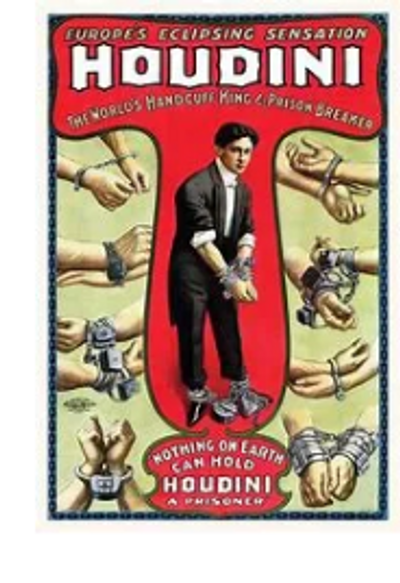
Houdini offered cash prizes to anyone who could produce handcuffs he couldn’t escape from.
Blacksmiths, police officers, and locksmiths tried. None succeeded.
He would lie underwater for minutes at a time, building lung capacity and calmness. Bess reportedly had to check on him constantly to make sure he hadn’t passed out.
He bought hundreds of fake spirit photos — not to expose them, but to study them. He believed understanding the mechanics of deception was the only way to defeat it.
The demonstration was meant to prove the security of the U.S. mail system. Instead, Houdini escaped in minutes, leaving officials stunned
Houdini carried multiple watches and often synchronized them before a show. He believed every escape had an “ideal rhythm,” and he practiced until he could hit it instinctively.

Stories are that he rehearsed the stunt and even took the coffin on his tour but never performed the trick.
He joined the Masons surprisingly late — in 1923 Houdini was already a global celebrity when he petitioned St. Cecile Lodge No. 568 in New York City. He was 49 years old — not a young man seeking identity, but a seasoned performer seeking continuity and tradition.
He believed that if he could perform a stunt blind, he could perform it under any conditions. Assistants described hearing only metal clicks and slow breathing from the darkened room.
Houdini traveled with a trunk that had secret compartments for lockpicks, cuffs, and gimmicks. Customs officers often searched it and found nothing.
In one challenge, the cell door was sealed with rivets instead of a lock. Houdini escaped anyway — by slipping through a tiny ventilation opening after disassembling part of the cell from the inside.
Houdini learned to tense specific muscles to make his wrists temporarily larger. This allowed him to appear tightly cuffed, then relax and slip free

Houdini saved every contract, telegram, and receipt. He believed future historians would need a complete record — and he was right.
A snowstorm stranded most of the crowd, but Houdini insisted the show go on. He performed the full program anyway.
A manufacturer challenged him with a safe sealed by fresh welds, not a lock. Houdini escaped anyway by exploiting a structural weakness in the metal.
Receipts, telegrams, ticket stubs, drafts, doodles — nothing was too small. He once said, “History is made of trifles,” and he meant it
Houdini studied the mechanics of doors everywhere he went — hotels, theaters, train cars. Assistants joked that he couldn’t enter a room without inspecting the hinges.
Unless it was staged or purposeful, Houdini disliked candid photos. He believed every image should contribute to the myth.

To simulate numbness during cold‑water stunts, Houdini trained with ice in his hands so he could still manipulate locks when his fingers were stiff.
His first buried‑alive test nearly killed him. He later said the experience haunted him more than any underwater stunt.
He sometimes sent unsigned praise to performers he thought deserved encouragement. He didn’t want his fame to overshadow the gesture.
If a book mentioned magic, spiritualism, or deception, Houdini often bought every edition he could find.
His library contained duplicates, triplicates, and even entire shelves of variations.
During a European tour, Houdini did an entire handcuff challenge without speaking a single word.
The audience reportedly held their breath through the whole act.
Houdini owned rare padlocks, manacles, and restraints from around the world. He studied them like puzzles, often disassembling them to understand their “personality.”

Dash became a Mason as well, reinforcing how intertwined their lives were — even in private, symbolic spaces.
In letters to close friends, Houdini admitted Dash had “the better hands” and a more instinctive feel for locks. Harry’s edge was discipline, not talent.
The name “Hardeen,” the tagline “Monarch of Manacles,” even the early publicity photos — all crafted by Houdini. Dash would later joke that he was “a franchise before franchises existed.”
In their early Coney Island days, the brothers practiced by trapping each other in trunks, cabinets, and even bedframes. Neighbors complained about “metallic banging at all hours.”
Houdini originally accomplished the escape behind a curtain. Dash was the one who stepped forward, climbed onto a chair, and let the audience watch every contortion. Houdini adopted the idea later.
In several cities, Houdini and Hardeen booked theaters across town from each other and let newspapers print stories about “brotherly competition.” Privately, they split the profits.

Houdini left Dash his props, illusions, and rights to perform his major escapes. But some notebooks were missing pages, and a few prototypes were never found. Historians still debate whether Houdini hid them intentionally.
The brothers shared a home in New York with Bess and Hardeen’s wife Elsie. Visitors described it as “a household of constant rehearsals, arguments, and laughter.”
When Houdini wanted to try a new escape — underwater, buried, or confined — Dash was the one he asked to supervise. Hardeen was the only person Houdini allowed to call off a stunt
Dash had a natural comedic timing that audiences adored. Houdini once said, “If I had his humor, I’d never need a handcuff.
He toured with Houdini’s illusions, debunked mediums, and kept the name alive. He saw it as a duty, not a career move.
Honoring Houdini’s wishes, Dash burned or dismantled certain apparatus so they could never be exposed or misused. Some of Houdini’s most famous secrets died with him.

He told Bess and his doctor that he “could not disappoint the audience,” even though he had been advised to go to the hospital immediately.
By 1926 he was performing with a broken ankle, fever, and severe pain. He insisted “the show must go on,” even after his appendix burst.
Just days before his collapse, Houdini gave a university lecture on fraudulent mediums.
Students later recalled he looked pale, sweating, and exhausted, but still spoke with absolute conviction.
According to Bess, his final whispered words were: “I’m tired of fighting.” A rare moment where the showman let the mask slip.
Doctors later estimated his temperature during the October 24 Detroit performance was well over 102°, possibly reaching 104. He still completed the entire two‑hour program
Contrary to popular myth, his last performance of the Water Torture Cell was days earlier. His final show in Detroit did not include the tank — he was too injured to perform it

On a very sad note, Harry, being Jewish, is buried in a Jewish cemetery and Bess, despite her years of devotion, is buried in a Catholic cemetery a few miles away. At that time, Jewish cemeteries didn't allow interfaith burials.
When Houdini died on October 31, 1926, the Society of American Magicians (SAM) created a new ritual specifically for him: the Broken Wand Ceremony. Before that moment, no such ceremony existed in the magic world.
The code was built from their old Vaudeville mind‑reading act, where they used a word‑substitution cipher to transmit information secretly.
The message Houdini promised to send was:
“Rosabelle, believe.”
But that wasn’t the whole code — that was just the surface phrase.
The real test was the letter‑by‑letter cipher behind it, which only Harry and Bess knew how to decode.
• “Rosabelle” was the title of a song Bess used to sing when they first met.
• “Believe” was the challenge — a dare to the afterlife and to the mediums who claimed to speak for it.
The full coded message translated to:
“Rosabelle, believe — answer, tell — pray, answer — look, tell — answer, answer — tell.”
Each word corresponded to a letter in their secret system.
Nobody ever delivered the correct message. For many years, Bess searched and listened, but never heard the sign from her beloved that he had returned to her.
For ten years, Bess held an annual séance on Halloween — the anniversary of his death — waiting for the code.
She never received it.
In 1936, on the tenth anniversary, she ended the tradition with the famous line:
“Ten years is long enough to wait for any man.”
She extinguished the candle she had kept burning for him.